Q&A with Professor Ng on Digital Statecraft, Market Coordination, and Design
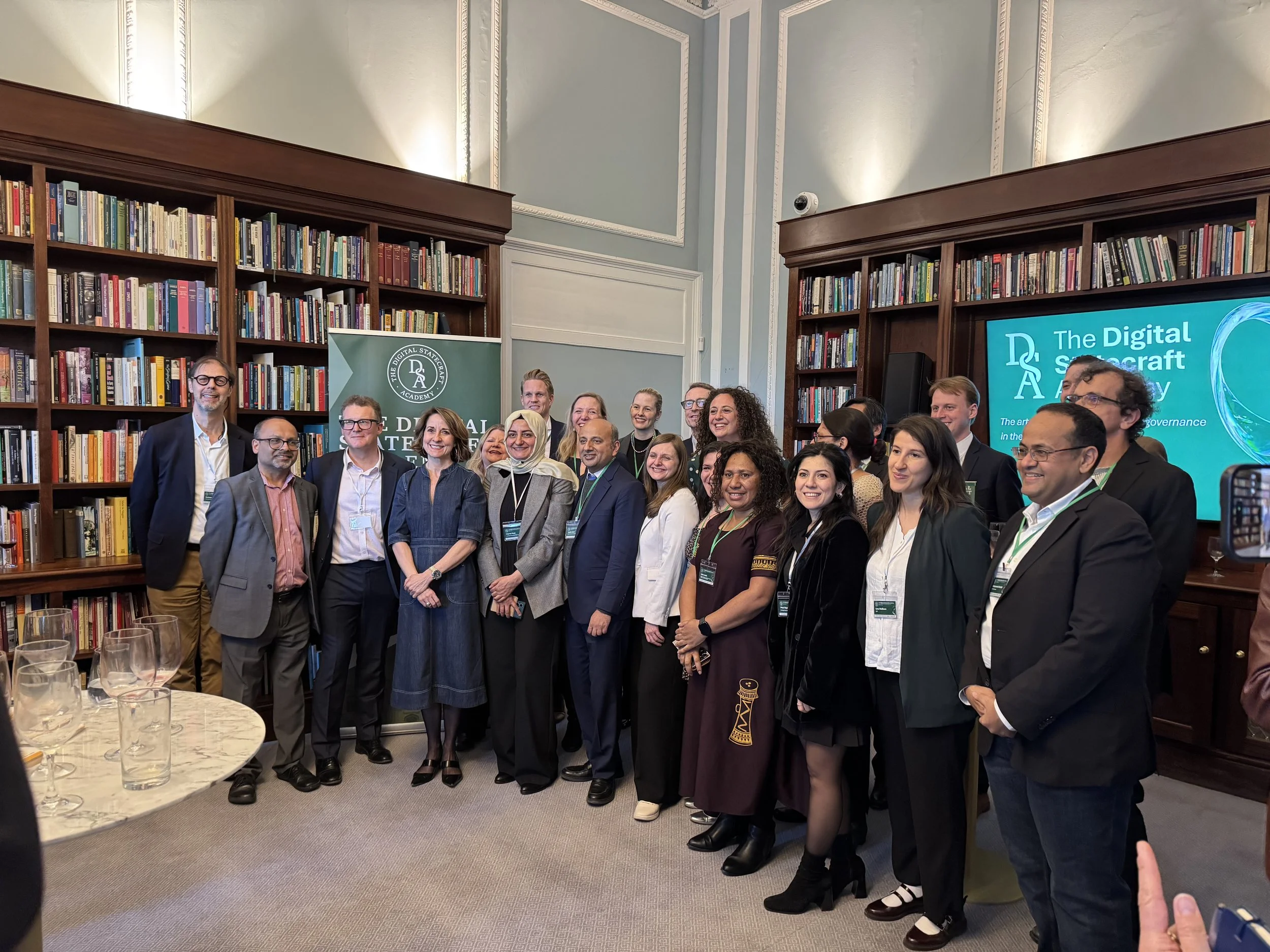
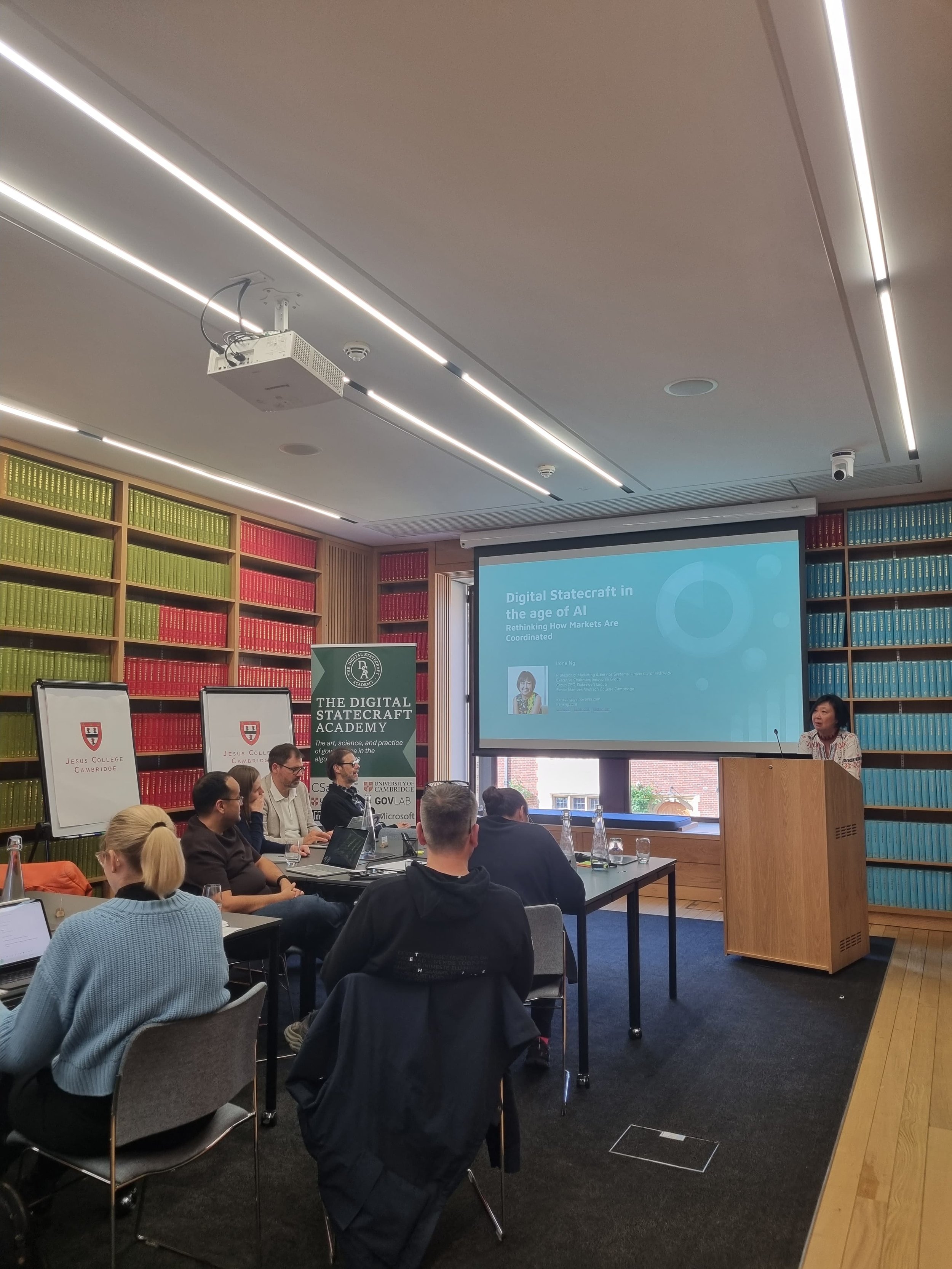
We sat down with Professor Irene Ng to ask her about her time at the Digital Statecraft Academy in Cambridge with the inaugural cohort of Fellows.
Justin Haslam (HATLAB Studio Manager):
You’ve just come back from Cambridge, spending time with participants of the Digital Statecraft Academy. Let’s start at the beginning — what is digital statecraft?
Professor Ng:
I would defer to the founders, Dr Zeynep Engin and Dr Tim Gordon — they are the ones who know this best and have shaped the concept. There is a manifesto. My understanding, echoing their thinking, is that digital statecraft is about how states understand, design, and exercise power in a world mediated by digital systems. It’s about governance, infrastructure, and coordination in a digital age.
Justin:
And who were the fellows you met?
Professor Ng:
An extraordinary group of 16 fellows across 15 countries working in very diverse areas of data / AI / governance — the inaugural cohort (link). Truly impressive: diverse, thoughtful, and deeply engaged. I’m confident they will go on to create meaningful impact in their respective areas. I feel very fortunate to have spent time with them.
Justin:
What did you actually do during your time there?
Professor Ng:
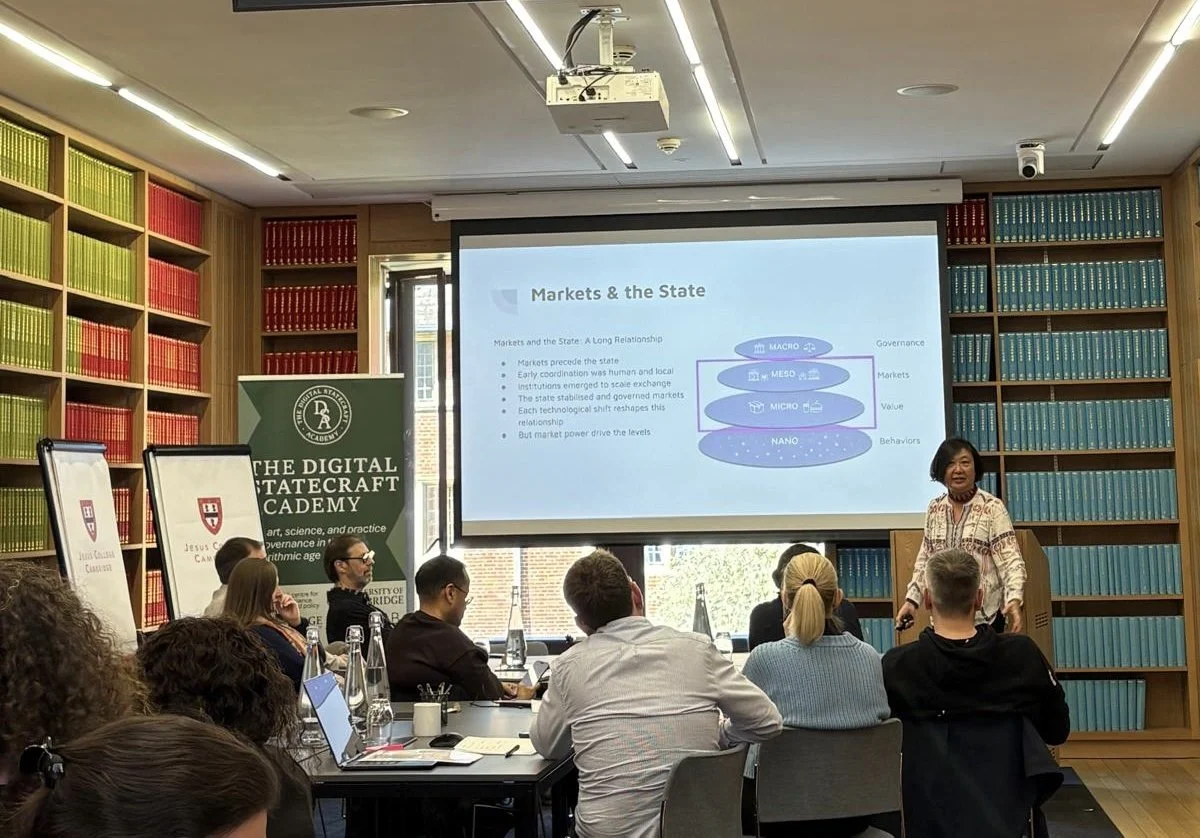
I presented my perspective on the role of digital statecraft — which, for me, is about going back to fundamentals of the state: how we govern and coordinate markets, especially in what I call the coordination economy.
Justin:
The coordination economy — explain that.
Professor Ng:
It’s the economy of the horizontal. These are services that coordinate parties within the exchange economy. They don’t deliver the end service themselves — they enable it.
Justin:
Can you give an example?
Professor Ng:
Yes — identity is a good one. A firm purchases a KYC service to verify someone’s identity. That verification enables the person to open a bank account. So the KYC service is part of the coordination economy, while banking is the exchange economy.
Another example is insurance - being able to provide insurance makes a difference on whether an exchange (eg buying a car) would happen. Again — coordination enabling exchange. Of course, the most obvious and biggest coordination service is payment. Advertising is also a coordination service that enables search and discovery and purchase of goods and services. It made Facebook and Google the titans they are today.
In my keynote, I also spoke about how platforms have absorbed much of this coordination role — and how AI will significantly amplify it. This has created efficiencies in exchange markets, “thinning out” large firms while also enabling smaller firms to grow and scale.
Justin:
Why is this distinction between coordination and exchange important for digital statecraft?
Professor Ng:
Because coordination started as a transaction cost of exchange - it still is - and then in a digital age, became outsourced to scalable platforms (think emails, storage, communications) and the data became siloed and is now reaching a choke point — coordination is the horizontal layer of the economy but horizontal flows are constrained by the siloes and now public institutions are attempting to fix it. For example, it should be really easy to bring verified health information from one healthcare provider to another to have a more holistic prognosis, right? Nope. Especially at scale. It’s also easy for countries to issue digital IDs and firms to create verified credentials. But to distribute it? Not so easy.
Justin:
And so the need for digital public infrastructure?
Professor Ng:
Well, that is one type of institutional form. The underlying issue is what I call the coordination trap:
For example, if a firm operates within an exchange market — say healthcare or finance — others are unlikely to trust it as a neutral coordinator of data. For example, would one bank rely on another bank’s KYC service? Unlikely.
But if data coordination is offered as a standalone service, it often becomes too variable and context-specific to scale across sectors — which can lead to market failure.
So the state feels it needs to do something. And that’s exactly where we are - calling for interoperability and governance to enable coordination markets to form instead of a winner takes all big tech solution— and yet no one is solving it. So platforms - especially A.I. workflows and coordination platforms - get bigger.
In my opinion, Digital Statecraft is a valuable initiative because it creates the space for these conversations.
We urgently need coordination markets, horizontal markets for data and A.I. — governance, standards, trust frameworks — but it’s unclear who can provide it effectively. The state? The market? Through regulation, legislation, or entirely new institutional forms?
The reality is: the market for data coordination is difficult to form — but the need for it has never been greater.
So the state must consider whether to provide it directly, or how to meaningfully incentivise markets to do so.
Justin:
Where do you see or think the coordinators will emerge?
Professor Ng:
Ha ha, I’m not answering that one. I have theses for some of my investment work, but I don’t think this is settled yet.
Justin:
So what did you take away from the few days you spent in Cambridge that’s useful for your work?
Professor Ng:
I agree with Zeynep and Tim — we need to keep the conversation going. These are not settled questions.
Personally, I lean toward designing markets as a form of governance rather than regulation. I see data as behaviour, and AI as a form of coordination intelligence. That suggests we should design governance systems that enable markets — because markets provide choice and freedom. And markets provide the scale necessary to let citizens and small firms have a voice and participate in the economy. A particular annoyance of mine is when governments say they’ve considered the market, they often mean they have consulted big firms in the private sector. In my presentation, I highlighted that in many countries, more than half the labour force are now small and micro firms and the numbers are increasing. I don’t equate the “private sector” with the market. That’s just poor understanding of markets and institutions.
Justin:
You talk a lot about design. Why is that so important here?
Professor Ng:
Because there’s a significant gap between learning and practice — particularly when it comes to markets, coordination, and institutional forms.
We design houses before building them. We design equipment before producing it. Yet we don’t design a market level coordinating system but jump straight into a tech solution. Policy makers often do not think of markets as needing intentional design. They need to.
Continuing the house analogy, the designer (i.e. architect) needs to be trained, the government needs to be involved (building safety & standards), the suppliers & even the owners need some level of understanding as well. We need to move toward a design approach to horizontal markets and new institutional forms and structures — not just regulatory frameworks or governance mechanisms — and crucially, create environments where these designs can be tested and validated.
Justin:
And this connects to SEE-ME and your Learning by Design program?
Professor Ng:
Exactly. Before we can design the horizontal, we need to understand the fundamentals — particularly institutional theory and institutional economics.
That’s what I teach in the foundational module. I am, of course, promoting it — but I genuinely believe it’s necessary groundwork.
Justin:
Who should attend?
Professor Ng:
Policymakers, regulators, and anyone seriously engaging with data and AI governance. If you understand markets through an institutional lens, you are far better equipped to shape meaningful policy.
Justin:
And SEE-ME is free?
Professor Ng:
Yes — because I’m still experimenting. I’m trying to understand the minimum level of institutional economics knowledge required to shape effective AI and data policy.
So tthe course is free, and in return, participants give me feedback. It’s part of the design process.
Justin:
So what’s next for digital statecraft?
Professor Ng:
There is a Data for Policy Call for Papers out. A lot of conversations in the past have been about technology. I am happy that data and governance have finally been given the recognition. I still think institutional and market design is a missing piece in the conversations and I would urge my peers in this area to contribute but researchers are an eccentric lot (including me, ha ha). They only like to work on what’s interesting to them and what I call meso and micro level focused academics (see the blog post on this) don’t usually play in macro or nano level spaces but the world is changing and the changing institutional forms and arrangements are so pervasive that maybe we can persuade them to be more involved. I need to find a way to get my peers involved in this space. :)
Justin:
Thank you for your insights.
****
For more information on the Data for Policy call for papers, go to:
https://dataforpolicy.org/data-for-policy-2026/
For more information on Digital Statecraft Academy, go to:
https://digitalstatecraft.academy
For more information on the foundational online course on markets and ecosystems conducted by Professor Ng, go to:
https://dataswyft.notion.site/see-me-program?source=copy_link